Capabilities 20 Years Manufacturing ,Exported to 112 Countries,OEM & ODM
Capabilities 20 Years Manufacturing ,Exported to 112 Countries,OEM & ODM

Choosing the right wheel tractor is essential for maximizing productivity and ensuring efficient farm operations across different tasks.
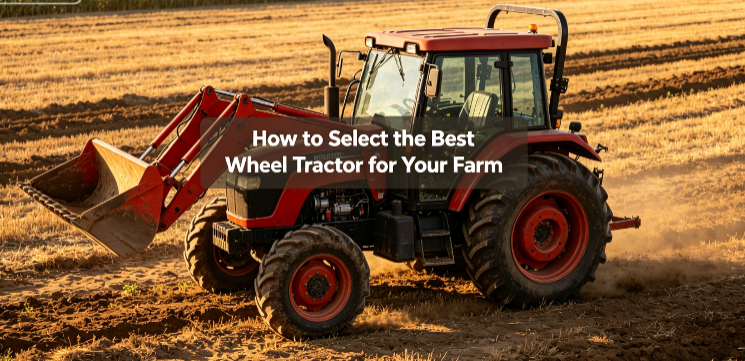
For modern farm operators, wheel tractor acts as the core power hub for almost all agricultural workflows. Plowing, seeding, fertilizing, hay baling, hauling and land clearing all rely on a reliable farm tractor. Selecting an unsuitable wheel tractor will lead to low working speed, high fuel consumption and even damage to farmland. This guide walks through the main advantages of wheel tractor, horsepower selection rules, common tractor attachments, and the value of 4WD system. You can discover full wheel tractor product range from Haochen Machinery.
What are the main advantages of a wheel tractor?
Compared with crawler tractors, wheel tractor features excellent mobility on hard roads and flat farmland. It can drive on public roads without special transport vehicles, which saves huge transfer time between different farm plots. A wheel farm tractor is flexible for frequent short-distance movement, making it ideal for diversified family farms and medium-sized agricultural plantations.
High maneuverability is another core benefit. Wheel tractors have a smaller turning radius, convenient for working in crop rows and narrow field passages. As versatile farming equipment, wheel tractors can match dozens of attachments to finish different farm jobs. The agricultural tractor also has lower maintenance cost in general working conditions. For farms mainly operating on dry, firm ground, wheel tractor brings higher cost performance. As a professional tractor manufacturer, Haochen supplies multiple models of diesel tractor suitable for global farming environments. More detailed parameters can be viewed at wheel tractor product page.
How to choose the correct horsepower for your needs?
Horsepower directly decides the load capacity and working capability of your tractor. Low horsepower compact utility tractor fits light-duty work: lawn mowing, small plot tillage, light trailer hauling and small orchard management, usually under 40HP.
Mid-range high horsepower tractor suits conventional farming, including plowing, rotary tillage and medium-size trailer transport, ranging from 40HP to 90HP. Large farms with heavy plowing, deep tillage and large hay baling tasks need tractors over 90HP.
You also need to take attachment requirements into consideration. If you plan to install heavy implements such as large plow, front loader, you need reserve extra horsepower. Pay attention to tractor PTO shaft parameters. PTO provides power for rotary tillers, mowers and harvesters. The PTO power must match the requirement of your farm implements. Buying a tractor with excessive horsepower wastes fuel and investment; insufficient horsepower leads to machine overload and accelerated wear.
What are the common attachments for wheel tractors?
The value of a wheel tractor is fully unlocked by supporting attachments. Front end loader is one of the most popular tools, used for loading soil, fertilizer, grain and farm materials. Rotary tiller is widely used for soil preparation before sowing.
Mower attachment for tractor helps cut grass in pastures and orchard ground. Trailers for material transport, plows for land turning, sprayer tanks for pesticide application are also frequently matched implements. Some users choose backhoe attachments to add digging function to wheel tractors, combining farming and light excavation.
When selecting attachments, confirm the connection method and PTO shaft specification. Buying attachments from the same tractor supplier ensures better compatibility. A complete set of matched implements allows one tractor to handle the whole farm cycle from land preparation to harvest transport.
Why is a 4WD system important for a farm tractor?
Two-wheel drive tractors are enough for flat, dry farmland and light work. However, 4WD tractor brings obvious advantages on sloped land, wet soil, muddy fields and heavy-load operations. 4WD system delivers power to all four wheels, which greatly improves traction and reduces wheel slipping.
On wet or soft soil, 4WD tractor can avoid getting stuck, reducing soil compaction caused by wheel slip. When pulling heavy plows or loaded trailers, four-wheel drive provides stronger pulling force. For farms with hilly terrain or seasonal rainy muddy land, 4WD tractor is a worthwhile investment. Even though the purchase price is higher, its stability and pass rate reduce work interruption and improve safety during field operation.
When you source tractors for sale, you should check local certification. CE certified tractor and EPA approved tractor meet regulatory requirements for North America and European market. Working with a reliable farm machinery supplier guarantees machine quality and spare parts supply for long-term farm production.
To conclude, selecting the best wheel tractor needs comprehensive consideration of farm terrain, task types, required horsepower and supporting attachments. A well-matched wheel tractor will become the core power equipment of your farm and continuously raise your agricultural production efficiency.
Our products are exported worldwide covering regions such as Europe,Southeast
Address Room 1508, Building 1, Xixi Fortune Center, Qingjiang Road, Shibei District, Qingdao City, Shandong Province.266011
Address Room 1508, Building 1, Xixi Fortune Center, Qingjiang Road, Shibei District, Qingdao City, Shandong Province.266011
Copyright © 2026 Shandong Haochen International Trade Co., Ltd. All Rights Reserved.
POWERED BY HICHENG

Copyright © 2026 Shandong Haochen International Trade Co., Ltd. All Rights Reserved.
POWERED BY HICHENG

We will contact you within 24 hours.


 English
 Português
 Français
 Árabe
Árabe
 Русский
 Español
 Deutsch
 日本語
日本語
 한국어
한국어
 हिंदी
हिंदी
 Türkçe
 Tiếng Việt
 Italiano
 ไทย
ไทย


